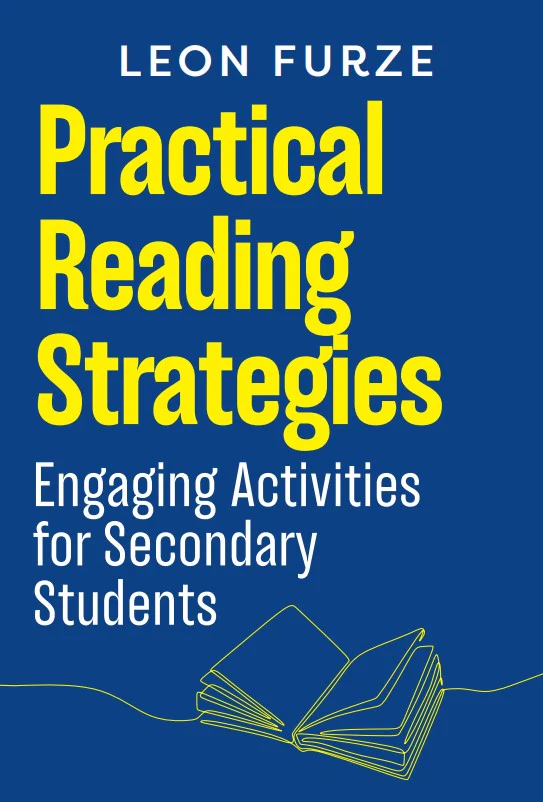
By Leon Furze
Practical
Reading
Strategies
Engaging Activities for Secondary Students
Six research-backed reading strategies with 24 classroom-ready activities to develop student reading skills across the curriculum.
The Framework
Six strategies to transform reading instruction
Developed through a research partnership with the Victorian Association for the Teaching of English (VATE), the Reading Strategies provide a framework for developing the many complex facets of reading. Each strategy targets a different cognitive skill, mapped to Bloom's taxonomy.
The Strategies
24 classroom-ready activities
Each strategy includes four unique activities with teacher instructions, student handouts, worked examples, and extension ideas.
Making Connections
Activating prior knowledge to build meaning
- Connections Coding
- Connections Text Walk
- Context Walk
- Connections Map
Visualising
Creating mental images to deepen comprehension
- Sensory Scenes
- Soundscapes
- Line-by-Line Visualisation
- Reading in Role
Questioning
Asking purposeful questions to drive deeper thinking
- Four Questions
- Why? Why? Why?
- Text Interrogation
- Deep Questions
Inferring
Reading between the lines to uncover hidden meaning
- QPCI
- Read Between the Lines
- Meaning Map
- How Do They Feel? How Do You Know?
Summarising
Distilling key ideas with precision and clarity
- Guided Summary
- Key Idea Paraphrase
- 10 Words or Less
- Elevator Pitch
Synthesising
Combining ideas to create new understanding
- Mega Map
- Strategy Hub
- Synthesising Mood Board
- The Text File
Beyond the Classroom
From individual activities to whole-school transformation
Part Two of the book expands the Reading Strategies from individual classroom activities into unit planning, assessment design, curriculum development, and school-wide reading culture.
Combining Strategies
The six Reading Strategies are not hierarchical — they can be combined and used flexibly. This chapter explores how activities from different strategies can be woven together within a single lesson or sequence, and how one activity can serve multiple strategy areas with small adjustments.
Constructing a Unit of Work
A practical guide to embedding the Reading Strategies within a complete unit of work. Includes worked examples showing how strategies can be sequenced across a term, with activities building on one another to develop student reading skills progressively alongside content knowledge.
Folio-based Assessment
The Reading Strategies lend themselves naturally to folio-based assessment, where students compile a portfolio of reading activities over time. This chapter explores how to design and manage folio assessments that authentically capture student reading development rather than relying solely on traditional tests.
Developing an English Curriculum
How to embed the Reading Strategies at the faculty level, building a coherent English curriculum where reading skills are explicitly taught and developed across year levels. Includes guidance on whole-faculty planning, vertical alignment, and ensuring consistency of approach.
Reading Across the Curriculum
Reading is not just an English subject skill — every discipline involves reading. This chapter provides examples of the Reading Strategies adapted for use in Science, Humanities, The Arts, and Technology, with sample activities and resources for cross-curricular literacy.
Creating a Culture of Reading
Beyond the classroom strategies, this chapter explores whole-school approaches to building a culture of reading: structured silent reading programs, classroom libraries, author visits, celebrating reading events, book clubs, and developing a shared vision for reading across the school community.
Get the book
24 activities, worked examples, student handouts, and a complete framework for teaching reading across the curriculum.